

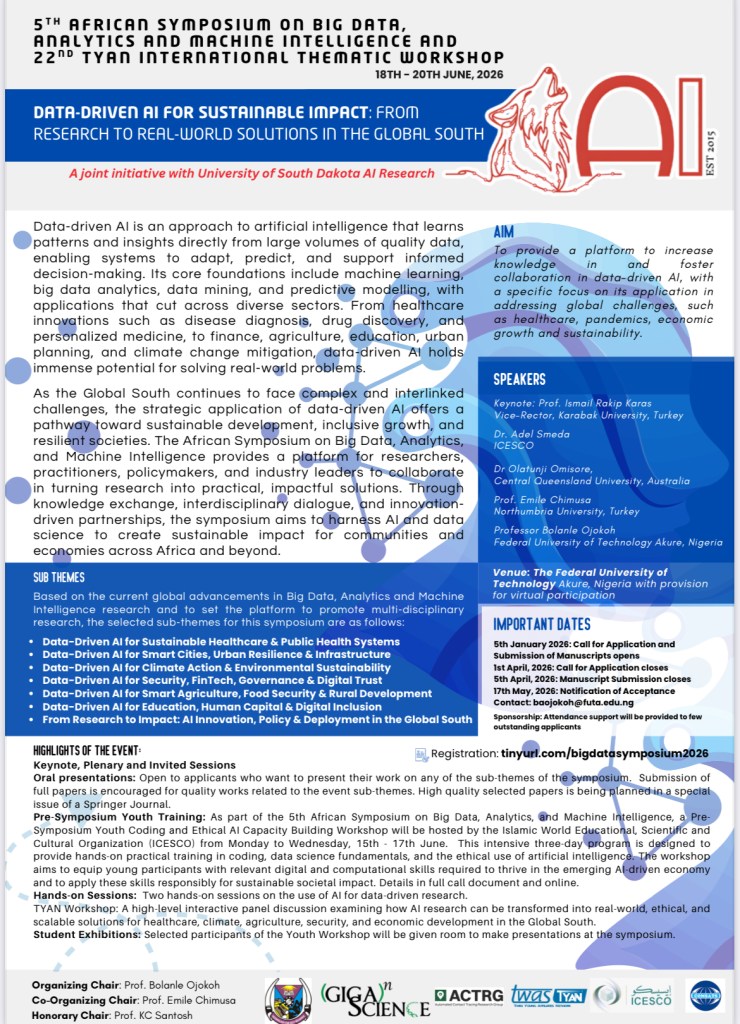
5th African Symposium on Big Data, Analytics & Machine Intelligence and TYAN International Thematic Workshop: A joint initiative with University of South Dakota, AI Research Lab
Theme:
Data-Driven AI for Sustainable Impact: From Research to Real-World Solutions in the Global South
Dates: 18–20 June 2026
Venue: Akure, Nigeria
Mode: Hybrid (Physical & Virtual Participation)
About the Symposium
The African Symposium on Big Data, Analytics, and Machine Intelligence is a flagship international forum that brings together researchers, practitioners, policymakers, industry leaders, and young innovators to explore how data-driven artificial intelligence (AI) can be translated from research into impactful real-world solutions.
Grounded in machine learning, big data analytics, data mining, and predictive modelling, data-driven AI offers powerful tools for addressing complex challenges in healthcare, climate action, agriculture, finance, education, urban development, and governance. For Africa and the wider Global South, these technologies provide pathways toward sustainable development, inclusive growth, and resilient societies.
The symposium provides a collaborative platform for interdisciplinary dialogue, innovation exchange, and partnership building, with strong emphasis on Africa-centric and Global South-relevant solutions, supported by leading academic and international partners across Africa, Europe, and North America.
Aim & Objectives
Aim
To advance knowledge, collaboration, and innovation in data-driven AI, with a focus on addressing global and regional development challenges.
Objectives
- Foster interdisciplinary collaboration among researchers, practitioners, and policymakers
- Showcase cutting-edge research and applied AI solutions for sustainable development
- Identify emerging trends, opportunities, and challenges in data-driven AI
- Develop actionable recommendations for accelerating AI adoption in the Global South
Symposium Sub-Themes
- Data-Driven AI for Sustainable Healthcare & Public Health
- Data-Driven AI for Smart Cities, Urban Resilience & Infrastructure
- Data-Driven AI for Climate Action & Environmental Sustainability
- Data-Driven AI for Security, FinTech, Governance & Digital Trust
- Data-Driven AI for Smart Agriculture, Food Security & Rural Development
- Data-Driven AI for Education, Human Capital & Digital Inclusion
- From Research to Impact: AI Innovation, Policy & Deployment in the Global South
Programme Highlights
🔹 Keynote, Plenary & Invited Sessions
Insights from leading experts on advances in big data, analytics, and machine intelligence.
🔹 Oral & Paper Presentations
Original research aligned with the symposium sub-themes.
Selected high-quality papers will be considered for publication in a planned Springer special issue.
🔹 Hands-On AI Sessions
Two practical sessions focused on applied AI and data-driven research methods.
🔹 Pre-Symposium Youth Coding & Ethical AI Bootcamp
15–17 June 2026
A three-day intensive programme equipping African youth with skills in coding, data analytics, and ethical AI.
Outstanding participants will present during the main symposium.
🔹 TYAN International Thematic Workshop
A high-level interactive panel discussion on turning AI research into ethical, scalable, and impactful real-world solutions across healthcare, climate, agriculture, security, and economic development.
🔹 Student Exhibition
Selected youth innovators showcase AI- and data-driven solutions.
🔹 Sponsorship & Attendance Support
Limited support available for outstanding applicants.
Important Dates
- 5 January 2026 – Call for Papers & Applications Opens
- 5 April 2026 – Manuscript Submission Deadline
- 17 May 2026 – Notification of Acceptance
Participants
The symposium will host participants, including:
- Undergraduate students (through the Youth Bootcamp and Student Exhibition)
- Master’s and PhD students
- Early-career researchers
- Senior scientists and industry experts
Organizing Chair: Prof. Bolanle Ojokoh
Co-Organizing Chair: Prof. Emile Chimusa
Honorary Chair: Prof. KC Santosh
Speakers
Prof. Ismail Rakip Karas
Vice-Rector, Karabük University, Türkiye
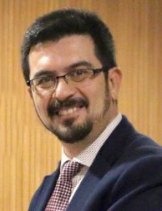
Prof. Dr. Ismail Rakip Karas is a Professor in the Computer Engineering Department and Head of the 3D-GeoInformatics Research Group at Karabük University, Türkiye, where he currently serves as Vice-Rector. He obtained his BSc from Konya Technical University, MSc from Gebze Technical University, and PhD in GIS and Remote Sensing from Yildiz Technical University.
His research focuses on Geoinformation Science, GIS, Remote Sensing, and 3D Geo-Informatics. He has been a visiting researcher at Oregon State University, USA, and Universiti Teknologi Malaysia. Prof. Karas has held several academic leadership roles at Karabük University, including Dean of the Faculty of Fine Arts and Design, Acting Dean of the Faculty of Architecture, and Director of Safranbolu Vocational School.
He served on the Executive Committee of TÜBİTAK (The Scientific and Technological Research Council of Türkiye) and has been invited as a keynote speaker at numerous international conferences. Prof. Karas has authored over 200 publications and has been actively involved in national and international research projects, while also serving on the editorial boards of several international journals.
Dr. Adel Smeda
Islamic World Educational, Scientific and Cultural Organization (ICESCO)
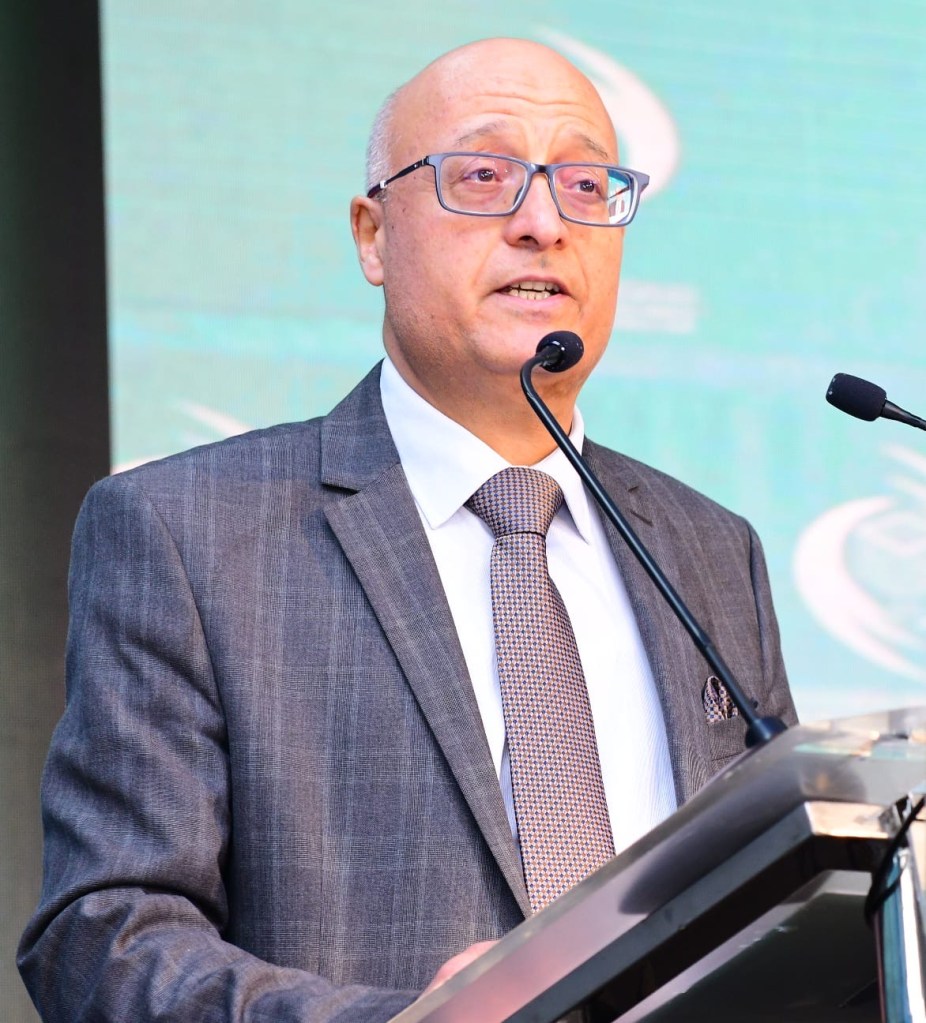
Dr. Adel Smeda is the Supervisor of the Sciences and Environment Sector at Islamic World Educational, Scientific and Cultural Organization (ICESCO). He holds a Ph.D. in Computer Science from University of Nantes, France, and has extensive experience in science policy, digital transformation, and innovation for sustainable development. At ICESCO, he leads strategic initiatives that promote the application of emerging technologies—including artificial intelligence, automation, and data-driven solutions—to address environmental challenges, strengthen research capacity, and foster international scientific collaboration across member states.
Prof. Emile Chimusa
Northumbria University, United Kingdom
Prof. Bolanle Ojokoh
Federal University of Technology, Akure, Nigeria

Prof. Bolanle Adefowoke Ojokoh is a Professor of Information Systems at the Federal University of Technology, Akure (FUTA), Nigeria, and is currently on sabbatical appointment at the Federal University of Technology and Environmental Sciences, Iyin-Ekiti, Nigeria. Her research focuses on Artificial Intelligence (AI), Big Data Analytics, Health Informatics, Recommendation Systems, and Information Filtering, with applications in digital health, sustainable development, and data-driven decision systems. She has authored over 100 peer-reviewed publications in leading international journals and conference proceedings. Prof. Ojokoh is a Fellow of the African Academy of Sciences and a TWAS Young Affiliate. She previously served as Co-Chair of the TWAS Young Affiliates Network (TYAN) and is a member of the TWAS Task Force on AI and Data Science for the Global South. She also serves on the Technical Advisory Committee of COMSATS and the TWAS Committee on Pandemics. She has delivered invited talks at major international scientific forums, including speaking on AI at the Science and Technology in Society (STS) Forum in Kyoto, and participating in TWAS General Conferences. She leads the Automated Contact Tracing Research Group (ACTRG) at FUTA.
Dr. Hasan Aljabbouli
New York University, USA
Dr Oluwarotimi Samuel
University of Derby, UK
Dr Olatunji Omisore
Central Queensland University, Australia.
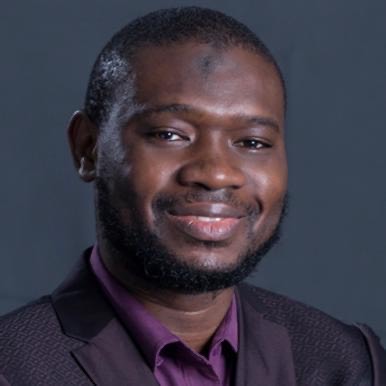
Olatunji is a Lecturer in ICT(AI and Robotics) at the Central Queensland University, Australia. He obtained a PhD degree in Pattern Recognition and Intelligent Systems from the University of the Chinese Academy of Sciences. His research aims to reduce global mortality and morbidity associated with cancer and cardiovascular diseases. Dr. Omisore worked as CAS-PIFI Postdoctoral Fellow and Research Associate Professor at the Shenzhen Institute of Advanced Technology (2019 - 2025) where he secured multiple grants to develop AI-driven methods and surgical robotic systems for endovascular interventions. Olatunji's research has profound impacts, with 60+ articles published, 3100+ citations (h-index of 28), 5 international patents on prototyping three robotic systems, and industrial collaboration experience. Dr. Omisore has successfully co-supervised multiple HDR students at PhD and master levels. He is a (senior) member of several professional bodies including the Institute of Electrical and Electronics Engineers, Association for Computing Machinery, and Australian Computer Society.

Additional speakers to be announced.
Partners & Collaborators
- Automated Contact Tracing Research Group (ACTRG), FUTA
- GigaScience Press
- TWAS Young Affiliates Network (TYAN)
- ICESCO
- COMSATS
- Karabük University
- University of South Dakota Artificial Intelligence Research Lab, USA
Expected Outcomes
- Capacity building for researchers, students, and industry professionals
- Identification of niche research areas addressing regional challenges
- Strengthened scientific networks and long-term collaborations
- New multidisciplinary and international research partnerships
- Contributions to key UN Sustainable Development Goals (SDGs)
Why Attend?
- Learn from global leaders in AI and data science
- Gain hands-on experience with real-world AI tools
- Network with researchers, policymakers, and industry partners
- Access publication and collaboration opportunities
- Help shape AI-driven solutions for sustainable impact in the Global South
 African Symposium on Big Data, Analytics and Machine Intelligence